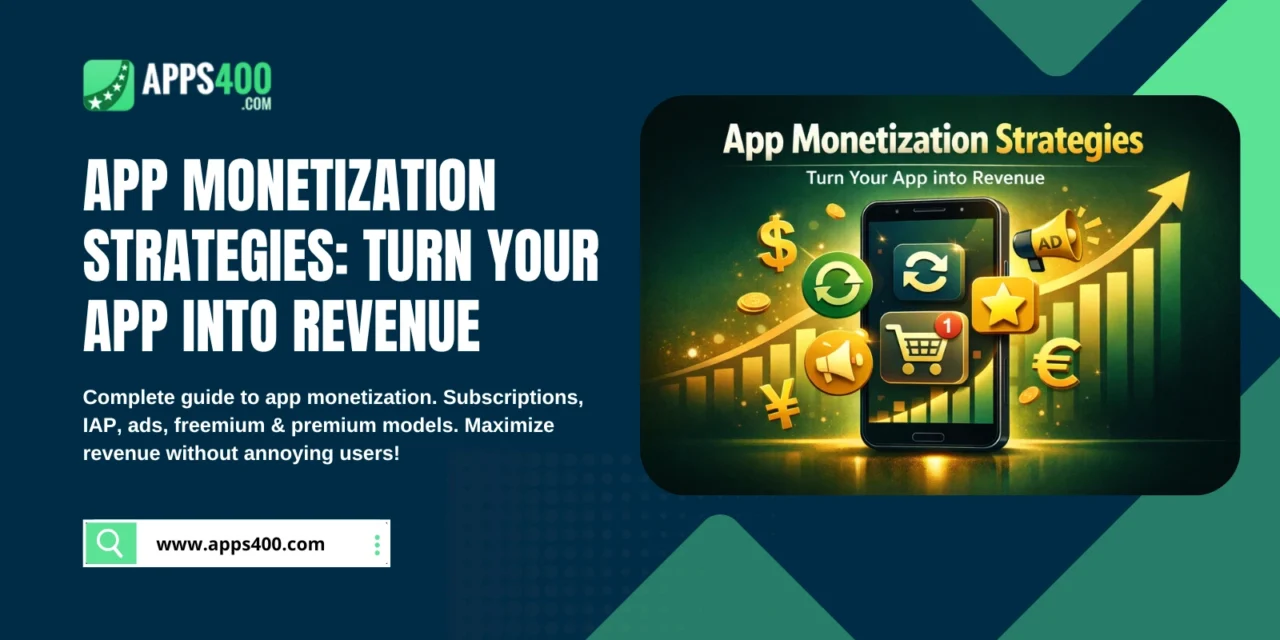
Creating an exceptional mobile application represents only half the challenge—generating sustainable revenue separates hobbyist projects from thriving businesses. App monetization strategies determine whether your app becomes a financial success or joins the 80% of apps that generate less than $500 monthly despite quality development and useful features.
The global mobile app market generates over $400 billion annually, yet most developers struggle to capture meaningful revenue shares. Understanding proven app monetization strategies, implementing them thoughtfully, and optimizing based on user behavior transforms apps from cost centers into profitable ventures that fund ongoing development and growth.
Understanding the App Monetization Landscape
Successful app monetization strategies align with your app’s value proposition, target audience, and competitive positioning. No single approach works universally—fitness apps monetize differently than productivity tools, while game monetization differs entirely from utility applications. Your strategy must complement rather than conflict with user experience.
iOS and Android platforms exhibit different monetization patterns. iOS users spend significantly more per capita on apps and in-app purchases, making premium pricing and subscriptions more viable. Android’s larger user base favors freemium models with ad support, though high-value users exist across both platforms.
The most successful apps often employ hybrid app monetization strategies, combining multiple revenue streams that cater to different user segments. Offering both free ad-supported and paid ad-free versions, or free basic functionality with premium feature subscriptions, maximizes revenue by monetizing users at their preferred price points. For developers exploring comprehensive strategies, understanding successful iOS applications and Android applications provides valuable monetization insights.
“The top 1% of apps generate 94% of app revenue, demonstrating that exceptional execution of app monetization strategies matters far more than simply having an app in stores. Success requires strategic planning, not just hoping users will pay.”
Freemium Model: Converting Free Users to Paying Customers
The freemium model dominates modern app monetization strategies, offering core functionality free while charging for premium features, content, or experiences. This approach removes download barriers while providing clear paths to revenue from engaged users willing to pay for enhanced capabilities.
Successful freemium implementation requires identifying which features drive conversions without crippling the free experience. Spotify allows free music streaming with ads and restrictions, converting users to Premium through unlimited skips, offline downloads, and ad removal. Evernote provides free note-taking while monetizing through increased upload limits, offline access, and team features.
The conversion rate from free to paid typically ranges 2-5% for freemium apps. While seemingly low, this converts meaningful revenue when combined with large user bases. Focus on growing your total user count while optimizing conversion funnels through better onboarding, strategic feature gating, and compelling upgrade prompts.
Optimizing Freemium Conversions
Effective app monetization strategies within freemium models use psychological triggers that encourage upgrades. Demonstrate premium feature value through limited trials, allowing users to experience benefits before restricting access. This “taste test” approach converts better than simply describing premium features.
Strategic friction in the free experience—waiting periods, feature limitations, or usage caps—motivates upgrades without rendering the app useless. Balance remains critical; excessive restrictions frustrate users into abandonment rather than payment. Monitor metrics relentlessly to identify optimal friction levels for your specific audience.
Subscription Model: Recurring Revenue Excellence
Subscription-based app monetization strategies generate predictable, recurring revenue that enables long-term business planning and sustainable development. Monthly or annual subscriptions create ongoing relationships with users, aligning your incentives with continuously delivering value rather than one-time transactions.
Apps providing ongoing value—content updates, cloud services, regular new features—suit subscription models perfectly. Headspace offers daily meditation content, Duolingo provides enhanced learning features, and productivity apps like Notion charge for advanced capabilities and increased capacity.
Implement free trials that demonstrate value before requiring payment. Seven-day or thirty-day trials convert significantly better than asking for immediate subscriptions. Auto-renewable subscriptions with clear cancellation processes build trust while reducing friction. For businesses seeking professional guidance on implementation, partnering with experts in mobile app development ensures your subscription infrastructure supports growth from launch.
Retention: The Subscription Challenge
Successful subscription app monetization strategies focus equally on acquisition and retention. Reducing monthly churn by even 1-2% dramatically impacts long-term revenue. Email users before trials end with clear value reminders, offer downgrade options before cancellation, and continuously add features that justify ongoing payments.
Price experimentation finds optimal subscription rates. A/B test different price points, trial lengths, and annual versus monthly options. Many apps discover that higher-priced annual subscriptions convert surprisingly well, as committed users prefer saving money through yearly payments.
In-App Purchases: Transactional Revenue
In-app purchases (IAP) represent flexible app monetization strategies enabling one-time payments for specific features, content, or consumables. Games use IAP extensively for power-ups, extra lives, or cosmetic items, while productivity apps might offer pro features, templates, or capacity increases.
Consumable purchases (coins, energy, boosts) encourage repeat transactions as users deplete purchased items through normal usage. Non-consumable purchases (feature unlocks, ad removal, content packs) provide one-time revenue but require broader user bases for sustainable income. Successful games often combine both, monetizing deeply through consumables while offering convenience purchases for less engaged users.
Apple’s StoreKit 2 and Google Play Billing provide robust frameworks for implementing in-app purchases across platforms. These systems handle payment processing, receipt validation, and purchase restoration across user devices, simplifying app monetization strategies implementation.
Advertising: Revenue from Free Users
Advertising-based app monetization strategies generate revenue from users unwilling to pay directly, monetizing attention rather than wallets. While per-user revenue remains lower than subscriptions or IAP, large free user bases create meaningful advertising income.
Multiple ad formats serve different contexts. Banner ads provide steady low-value revenue without interrupting experiences. Interstitial ads (full-screen) generate higher rates but risk annoying users if displayed too frequently. Rewarded video ads offer the best user experience—users voluntarily watch ads for in-app rewards (extra lives, currency, content unlocks), creating win-win scenarios.
Ad networks like Google AdMob, Meta Audience Network, and Unity Ads (for games) handle ad serving, targeting, and payments. Mediation platforms like AdMob Mediation automatically optimize between multiple networks, maximizing fill rates and eCPM (effective cost per thousand impressions).
Balancing Ads and User Experience
Poorly implemented advertising destroys user experience and drives uninstalls. Successful app monetization strategies using ads find the balance between revenue generation and maintaining quality experiences. Limit ad frequency—showing ads after every action frustrates users. Place ads at natural pause points in user workflows where they interrupt minimally.
Always provide ad-free premium options. Users willing to pay for ad removal become your most valuable customers, combining the benefits of large free user bases with direct revenue from those seeking better experiences. This hybrid approach maximizes total revenue while respecting user preferences.
Premium Paid Apps: Direct Purchase Model
While declining in popularity, paid apps remain viable app monetization strategies for specific categories. Professional tools, niche utilities, and premium games can justify upfront costs when providing clear, immediate value that differentiates from free alternatives.
Paid app success requires outstanding product quality, excellent reviews, and strong marketing since users won’t download to “try” your app. Price apps strategically—$0.99 to $4.99 suits casual purchases, while professional tools may command $9.99 to $49.99 based on value delivered. Research competitor pricing and position accordingly.
Premium apps face discovery challenges as users browse free alternatives first. Exceptional app store optimization becomes critical, ensuring your paid app ranks highly for relevant searches and converts browsers through compelling screenshots, descriptions, and reviews showcasing value worth paying for upfront.
Sponsorship and Partnership Models
Alternative app monetization strategies include sponsorships where brands pay for prominent placement within your app, or revenue-sharing partnerships with complementary services. Fitness apps partner with equipment manufacturers, travel apps with booking services, and productivity apps with enterprise software providers.
These arrangements work best when sponsors align naturally with your user base and provide genuine value. Forced or irrelevant partnerships damage credibility and user trust. Strava partners with athletic brands, creating authentic integrations that enhance rather than detract from user experience while generating significant partnership revenue.
Frequently Asked Questions About App Monetization Strategies
What’s the best app monetization strategy for beginners?
Freemium models with optional in-app purchases represent the most accessible app monetization strategies for beginners. This approach maximizes downloads by removing payment barriers while providing clear monetization paths through feature unlocks or content purchases. Start with core functionality free, then add premium features based on user feedback showing which capabilities users value most and would pay to access.
How much money can I realistically make from my app?
Revenue varies dramatically based on category, quality, and marketing. Average apps generate $500-$5,000 monthly, while successful apps with strong app monetization strategies earn $10,000-$100,000+ monthly. Top apps generate millions monthly. Focus on solving genuine problems, executing monetization thoughtfully, and marketing effectively rather than expecting passive income. Most successful app businesses took 1-2 years of iteration to achieve meaningful revenue.
Should I use ads or subscriptions?
The optimal choice depends on your app category and audience. App monetization strategies using ads suit broad consumer apps with large user bases where most won’t pay directly. Subscriptions work better for apps providing ongoing value through content updates, cloud services, or regular feature additions. Many successful apps offer both—free ad-supported versions plus premium ad-free subscriptions—capturing revenue from different user segments.
How do I price my app or subscriptions?
Research competitor pricing within your category as starting points for your app monetization strategies. Test different price points through A/B testing or regional variations to identify optimal rates. Consider psychological pricing ($2.99 vs $3.00), annual discounts encouraging longer commitments, and price increases for new users while grandfathering existing customers. Monitor conversion rates closely—lower prices don’t necessarily increase revenue if conversion gains don’t offset reduced per-user value.
Can I change my monetization strategy after launch?
Yes, though transitions require careful management. Many apps start with one approach then evolve their app monetization strategies based on user behavior and market feedback. Communicate changes transparently to users, grandfather existing customers when possible, and ensure new monetization doesn’t destroy previously free features users rely upon. Successful transitions often introduce new premium tiers while maintaining existing free functionality, adding rather than restricting.
Analytics and Optimization
Data-driven optimization separates amateur from professional app monetization strategies. Implement comprehensive analytics tracking user behavior, conversion funnels, churn rates, and revenue per user. Tools like Firebase Analytics, Adjust, and Amplitude provide insights into what drives monetization.
Track key metrics relentlessly: conversion rates from free to paid, average revenue per user (ARPU), lifetime value (LTV), and customer acquisition cost (CAC). Successful apps maintain LTV:CAC ratios above 3:1, ensuring customer value exceeds acquisition costs. Calculate payback periods—how long until acquired users generate profits—and optimize accordingly.
A/B test pricing, messaging, trial lengths, and feature positioning continuously. Small improvements compound dramatically over time. An app converting 2% of free users improving to 2.5% increases revenue 25% without additional user acquisition costs.
Common Monetization Mistakes to Avoid
Poor app monetization strategies implementation undermines even exceptional apps. Avoid aggressive monetization during initial user experiences—let users appreciate your app’s value before requesting payment. First impressions determine whether users continue engaging or immediately uninstall.
Don’t hide pricing information or make cancellation difficult. Transparent pricing builds trust, while subscription dark patterns (making cancellation intentionally difficult) generate short-term revenue but long-term reputation damage and poor reviews that hurt acquisition.
Resist constant monetization nagging. Showing upgrade prompts after every action frustrates users without increasing conversions meaningfully. Strategic, well-timed upgrade suggestions when users encounter premium feature value convert far better than annoying constant reminders. For insights into effective monetization implementation, studying successful mobile applications reveals patterns that balance user experience with revenue generation.
Regional and Cultural Considerations
Global app monetization strategies require adapting to regional preferences and purchasing power. Western markets accept subscription models readily, while many Asian markets prefer one-time purchases or microtransactions. Adjust pricing for regional economic conditions—$9.99 monthly might be reasonable in the US but prohibitively expensive in developing markets.
Payment method availability varies significantly by region. Credit card penetration remains low in many countries where mobile payment services or carrier billing prove essential for monetization. Ensure your implementation supports regional payment preferences, not just those common in your home market.
Cultural attitudes toward advertising differ substantially. Some regions tolerate higher ad densities, while others find even modest advertising intrusive. Research and respect local preferences when implementing app monetization strategies in new markets rather than assuming your home market approach transfers directly.
Future of App Monetization
Emerging app monetization strategies leverage new technologies and platforms. Web3 integration enables cryptocurrency payments and NFT ownership within apps, creating novel revenue streams for appropriate use cases, though this remains experimental and controversial.
Artificial intelligence personalizes monetization dynamically, showing different users optimal pricing and offers based on predicted willingness to pay. This personalization, implemented ethically with transparency, maximizes revenue while respecting user preferences and budget constraints.
Super apps combining multiple services into single platforms create cross-selling opportunities where users paying for one service discover and purchase others within the same ecosystem. This approach, pioneered in Asian markets, increasingly influences Western app monetization strategies as apps expand beyond single-purpose functionality.
Begin implementing proven app monetization strategies that align with your app’s purpose and audience. Start simple—choose one primary approach, implement it well, and optimize based on user behavior. As your app grows and you better understand your users, expand to hybrid strategies that maximize revenue across different user segments. Remember that sustainable monetization balances business needs with user value—extract revenue by delivering exceptional experiences users willingly pay for, not through manipulative tactics that generate short-term gains while destroying long-term viability. For additional guidance on building sustainable app businesses, exploring comprehensive app marketing strategies helps connect great monetization with effective user acquisition that drives growth.