Last updated: September 2026
Most apps that launched in 2013 are gone. KineMaster is not only still here, it has added a quarter of a billion downloads in the last four years alone. That makes it worth looking at properly — not as a quick verdict, but as a twelve-year record of how mobile video editing actually changed.
A timeline-based editor before phones were ready for one
KineMaster launched on Android on 26 December 2013, built by NexStreaming, a South Korean multimedia software company that later renamed itself KineMaster Corporation.
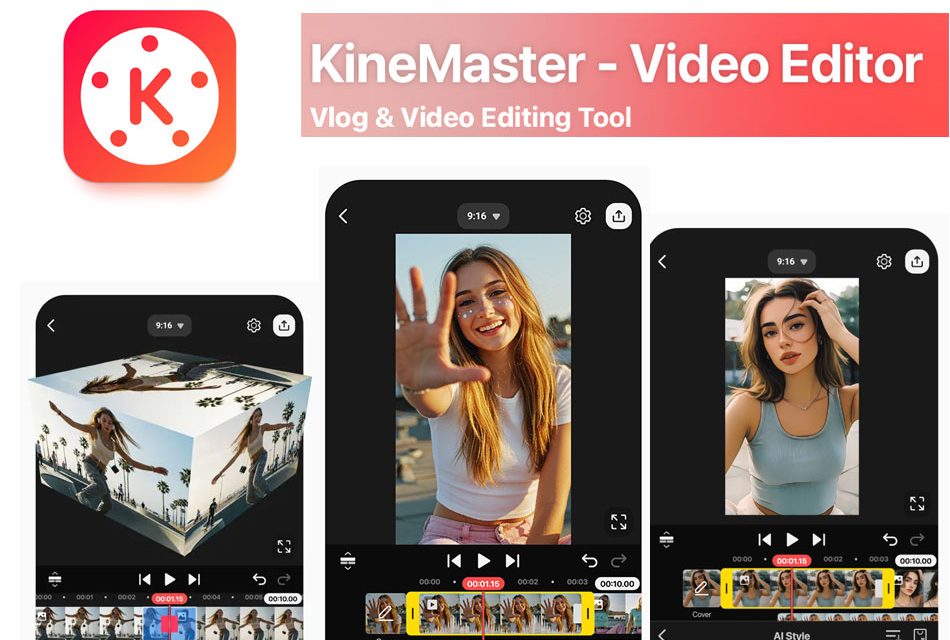
What made it unusual at launch was the ambition of the interface. In 2013, most mobile video apps offered trim, filter, share. KineMaster shipped with a multi-layer timeline and chroma key — features people associated with desktop software. It leaned on close work with mobile chipset performance to make real-time preview feasible on hardware that had no business running it.
That decision defined the app’s identity. KineMaster has always been the mobile editor for people who want manual control, not the one that does it for you.
The iOS version arrived considerably later, on 28 April 2017, bringing multi-layer editing, chroma key, keyframe animation and the asset store to iPhone and iPad.
Growth through the creator boom
The download numbers tell the story of the market more than the app:
| Milestone | Figure |
|---|---|
| 2022 cumulative downloads | 500 million |
| 2026 cumulative downloads | 750 million |
| Play Store rating | 4.4 stars, 5.8 million reviews |
| Position | Third most-downloaded mobile video editor |
Two hundred and fifty million new downloads between 2022 and 2026 lines up almost exactly with the global expansion of short-form video. CapCut leads the category with over a billion, with KineMaster and InShot in the next tier.
KineMaster also carries Google Play Editors’ Choice designation, and runs across phones, tablets and Chromebooks.
The vertical video rebuild
The most significant recent change is structural rather than cosmetic. KineMaster was designed around a landscape timeline, which made sense in 2013 and made progressively less sense as TikTok, Reels and Shorts turned vertical into the default.
Version 8.0, released in November 2025, added an optional vertical editing interface with auto-rotate and per-project orientation settings. Version 8.1, in March 2026, rebuilt text handling around a centralised control panel, added Word Swap animation, and integrated text-to-speech. Version 8.2, arriving July 2026, brings smart template recommendations and multi-layer timeline selection.
Rewriting the core editing interface twelve years in is a substantial engineering commitment. It suggests the company reads the vertical shift as permanent rather than a phase.
What the AI features actually do
KineMaster’s 2026 feature set includes auto-captions, background removal without a green screen, and Super Resolution upscaling for exports.
These are worth separating from the marketing. Auto-captions and background removal are now table stakes across the category — CapCut, InShot and Filmora all offer versions of them. What they change is not what is possible, but how long it takes. Work that took twenty minutes of manual keyframing takes one tap and a correction pass.
Free versus Premium in 2026
The freemium split is unusually generous on capability and unusually strict on branding.
Free tier: full multi-layer timeline, chroma key, keyframe animation, blending modes, audio envelopes, and export up to 4K. Almost every core editing feature is available.
The catch: every free export carries a KineMaster watermark. There is no way to remove it other than subscribing.
Premium removes the watermark and ads, and unlocks the full asset library — the larger transition, effect, font and music collections, and cross-device project sync.
Pricing varies by region. In most markets Premium runs roughly $8.99 per month or around $44.99 per year, though rates differ significantly by territory and promotional pricing appears regularly. Check the in-app price for your own region rather than relying on any published figure.
One practical note: the number of simultaneous video layers you can use depends on your device’s chipset, not on your subscription. Budget and older Android phones may manage only one or two layers regardless of what you pay.
Where it sits in 2026
KineMaster occupies a specific position rather than a dominant one. CapCut has far greater reach and tighter social integration. Filmora offers a desktop counterpart. KineMaster’s argument is manual, layer-based control on mobile, with a deep asset store and a workflow that rewards learning it.
For creators who want the app to make decisions, that is a weakness. For creators who want to make the decisions themselves, it remains one of the few mobile editors that lets them.
There is still no official desktop application, though a March 2026 update improved performance on Apple’s MacBook Neo hardware with 4K multi-layer support and desktop hotkeys.
The question the AI era raises
There is something genuinely interesting about where this leaves an app like KineMaster.
Its entire value proposition for twelve years has been giving people precise manual control on a small screen. The 2026 direction — auto-captions, one-tap background removal, template recommendations — moves toward the tool making choices on the user’s behalf. Those two ideas are in tension, and how KineMaster resolves it will matter more than any individual feature release.
The wider question is whether manual editing skill retains value when the automated version is close enough for most uses. For a quick Reel, probably not. For anything where the edit itself carries meaning, probably yes. Nobody knows where the line settles.
A note on this article: This is a factual overview of KineMaster’s history, features and pricing, compiled from public sources and verified in September 2026. It is not a hands-on review. Our editorial team is currently testing KineMaster 8.1 across Android and iOS, and we will publish a full review with real usage findings, export benchmarks and screenshots once that testing is complete.
If you have used KineMaster for a real project, we would like to hear about it. Email the editorial team at [email protected].