Grammarly has been the default grammar checker for students, professionals, and non-native English speakers for over a decade. In 2026 the company made a significant pivot – positioning itself not just as a proofreading layer but as a full AI writing co-pilot that actively improves how you communicate across every platform you write on. After testing it for forty-five days across fifteen different writing surfaces, here is the complete assessment.
What Grammarly Does in 2026
At its core, Grammarly still catches spelling errors, grammar mistakes, and punctuation issues in real time as you type. It works as a browser extension integrating directly into Google Docs, Microsoft Word, Gmail, Outlook, Slack, Notion, LinkedIn, and virtually every text input on the web. The installation is one click and the experience is seamless – suggestions appear as highlights and fixes apply with a single click.
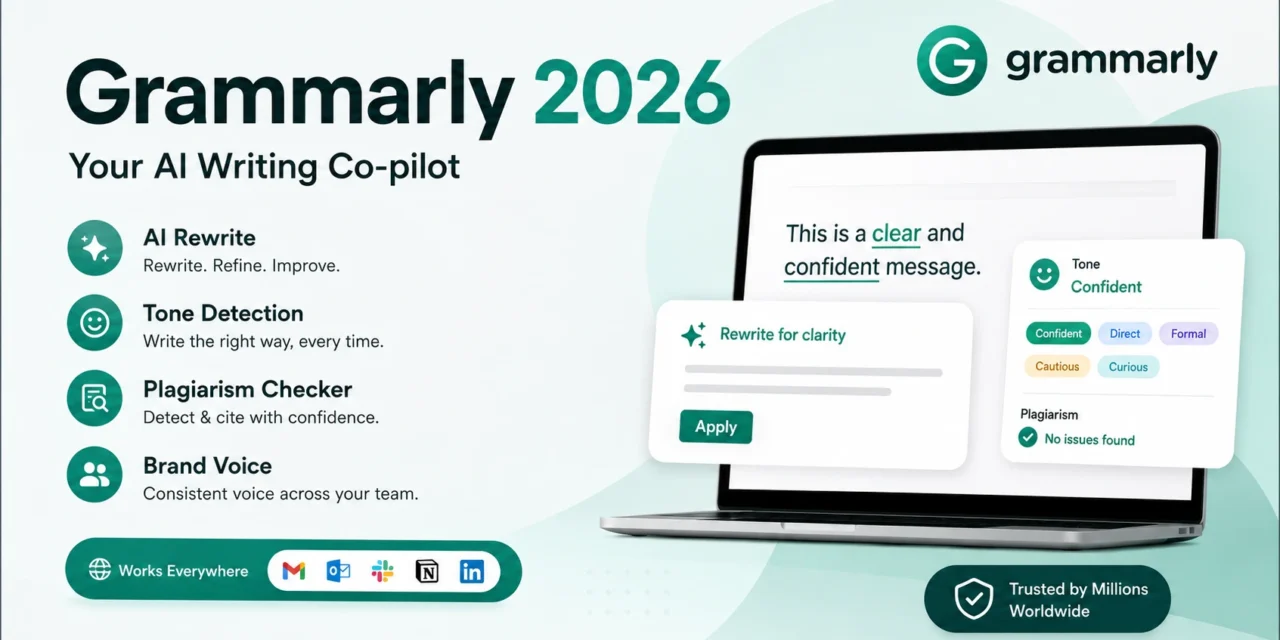
But the 2026 version adds a layer of capability that goes well beyond error correction. The AI rewrites, tone detection, and brand voice features turn Grammarly into something closer to a writing coach than a spell checker, and this shift has made it genuinely more valuable for professional use than in any previous year.
AI Full Sentence Rewrite
The AI rewrite feature lets you select any sentence or paragraph and ask Grammarly to rewrite it for different goals – make it clearer, more concise, more persuasive, or adjust the formality level. The output quality in 2026 is genuinely impressive. In testing across a variety of professional email scenarios, the rewrites were consistently better than the original text in both clarity and tone, with an accuracy rate that required only minor manual adjustments in most cases.
This feature alone saves meaningful time for professionals who write dozens of emails, proposals, or reports per week. The time cost of editing a rough draft is significantly lower when an AI can produce a structurally improved version in two seconds rather than requiring ten minutes of self-editing with diminishing returns.
Tone Detection – A Feature That Prevents Costly Mistakes
The tone detector analyses your message and shows how it is likely to land emotionally – labels like confident, direct, cautious, curious, or formal appear as coloured chips beneath your text. In testing, this feature prevented more than a few accidentally sharp emails by flagging messages that were meant to be firm but read as aggressive.
The accuracy of tone detection has improved significantly since 2024. It now picks up on subtle word choices that shift perceived tone rather than just flagging obviously rude or overly casual language. The practical value is highest in professional email contexts where the stakes of misread tone are real – a message perceived as dismissive by a client or senior colleague creates relationship friction that is difficult to repair.
Plagiarism Checker and Citation Suggestions
Grammarly Premium includes a plagiarism checker that compares your text against billions of web pages and academic sources. For students and content writers, this is a valuable safety net. The 2026 version added a source citation suggestion feature that shows where matched text appears and offers properly formatted citation options in APA, MLA, and Chicago styles. This combination of detection and remediation makes the plagiarism feature more useful than standalone checkers that only identify problems without suggesting solutions.
Brand Voice for Business Teams
Grammarly Business at fifteen dollars per user per month adds Brand Voice – a feature that learns your organisation’s writing style from existing documents and then checks all team writing against that style guide. When a team member types a discouraged phrase, Grammarly flags it and suggests the preferred alternative. For companies that care deeply about consistent communications across customer-facing content, this replaces hours of manual editing and copy-review cycles with an automated real-time check.
Mobile App Performance
The Android and iOS keyboard integration brings Grammarly suggestions into any text field on your phone. This works well in messaging apps, email clients, and social media – the corrections appear inline without requiring you to leave the app you are writing in. The keyboard requires a permissions grant that some users find intrusive, but the suggestion quality on mobile has improved enough in 2026 that the trade-off is worthwhile for heavy mobile writers.
Download the Android app on the Play Store or the iOS app on the App Store. Visit www.grammarly.com to start with the free plan.
Grammarly Free vs Premium
The free version covers basic grammar and spelling across all platforms. Grammarly Premium at twelve dollars per month when billed annually adds AI rewrites, full clarity suggestions, tone adjustments, and the plagiarism checker. The annual plan offers significantly better value than monthly billing – if you plan to use it for more than two months, annual billing is the correct choice.
Who Benefits Most
Non-native English speakers, professionals who write high volumes of business communications, students writing academic work, content marketers, and anyone who has ever felt uncertain about whether a draft says what they intended will all get consistent daily value from Grammarly Premium in 2026. The AI rewrite feature is the clearest indicator of whether you will find the subscription worth it – if clearer, more concise writing at speed matters to your work, the answer is yes.
Final Verdict
Grammarly 2026 is worth the Premium subscription for anyone who writes professionally. The AI features have crossed a threshold of quality where they genuinely save time and improve output rather than just adding noise. The tone detection and brand voice features specifically address real professional communication problems that no previous version of the tool tackled effectively.