Cross-Platform App Development: Build Once, Deploy Everywhere
Building separate applications for iOS and Android traditionally doubled development time, costs, and maintenance efforts. Cross-platform app development revolutionizes this approach by enabling developers to write code once and deploy it across multiple platforms, dramatically reducing expenses while accelerating time-to-market without sacrificing quality or performance.
Modern cross-platform frameworks have matured beyond their early limitations, now delivering near-native performance and access to device-specific features. Major companies like Alibaba, BMW, and Google itself rely on cross-platform app development for production applications serving millions of users, validating the approach for projects of any scale.
Understanding Cross-Platform App Development
Cross-platform app development uses frameworks that abstract platform-specific differences, allowing developers to create applications that run on iOS, Android, and often web browsers from a unified codebase. Instead of maintaining separate Swift/Objective-C code for iOS and Kotlin/Java for Android, developers write once in JavaScript, Dart, or other languages supported by their chosen framework.
This approach cuts development costs by 40-70% compared to native development for both platforms. Time-to-market decreases substantially since you’re building and testing one application rather than two separate ones. Maintenance becomes simpler—bug fixes and new features deploy to all platforms simultaneously rather than requiring duplicate work.
The trade-off? Slightly reduced performance in some scenarios and occasional limitations accessing the newest platform-specific features immediately upon release. However, for the vast majority of applications, these compromises prove negligible compared to the significant cost and time savings. For businesses exploring development options, understanding both iOS applications and Android applications helps inform whether cross-platform or native development better suits your project needs.
“Cross-platform frameworks now power over 42% of new mobile applications, with adoption accelerating as frameworks mature and businesses prioritize development efficiency without compromising user experience quality.”
Flutter: Google’s UI Toolkit
Flutter has emerged as the leading framework for cross-platform app development, earning praise for its beautiful UI capabilities, excellent performance, and comprehensive widget library. Developed by Google and written in Dart programming language, Flutter compiles to native ARM code, delivering performance indistinguishable from native applications.
Flutter’s hot reload feature enables developers to see code changes instantly without restarting applications, dramatically accelerating the development cycle. The framework’s widget-based architecture provides extensive customization options, creating pixel-perfect interfaces that match your design vision precisely.
Major apps built with Flutter include Alibaba, Nubank (serving over 70 million customers), and Google Ads. These production implementations demonstrate Flutter’s suitability for complex, performance-critical applications. For businesses seeking professional implementation, partnering with experts in comprehensive mobile app development ensures your Flutter project leverages best practices from the start.
Flutter’s Key Advantages
Flutter excels at creating visually rich, animated interfaces with smooth 60fps (or 120fps on capable devices) performance. The framework’s Material Design and Cupertino widget libraries enable platform-appropriate interfaces—Material for Android, Cupertino for iOS—while maintaining code reusability.
The growing Flutter ecosystem includes thousands of packages for common functionality—networking, state management, databases, authentication—reducing development time for cross-platform app development projects. Flutter’s web and desktop support means the same codebase can target six platforms: iOS, Android, web, Windows, macOS, and Linux.
React Native: Facebook’s JavaScript Framework
React Native pioneered mainstream cross-platform app development and remains wildly popular, particularly among teams with existing JavaScript expertise. Built by Meta (Facebook) and using JavaScript with React, React Native renders using native platform components rather than custom-drawn elements, creating interfaces that feel authentically native.
The massive JavaScript developer community means abundant talent availability and extensive third-party libraries for virtually any functionality. React Native’s architecture allows easy integration of native modules when platform-specific features are required, providing escape hatches for scenarios where pure cross-platform approaches fall short.
High-profile React Native applications include Facebook, Instagram, Airbnb (portions), and Walmart. These implementations showcase React Native’s ability to scale from consumer apps to enterprise solutions requiring robust performance.
When React Native Shines
Teams already proficient in JavaScript and React gain immediate productivity advantages with React Native for cross-platform app development. The learning curve for web developers remains gentle since concepts transfer directly from React web development.
React Native’s over-the-air update capabilities through services like Expo enable pushing bug fixes and features directly to users without App Store approvals, particularly valuable for time-sensitive updates. The framework’s mature tooling and debugging experience rival native development environments.
Comparing Flutter vs React Native
Choosing between frameworks significantly impacts your cross-platform app development project’s trajectory. Flutter generally delivers superior performance due to compilation to native code and avoidance of JavaScript bridges. Apps with complex animations, custom graphics, or games benefit from Flutter’s rendering engine.
React Native provides easier native module integration and benefits from JavaScript’s ubiquity—finding React Native developers typically proves simpler than sourcing Flutter/Dart specialists. However, Flutter’s growth has been explosive, with developer adoption increasing dramatically year-over-year.
UI development philosophies differ fundamentally: Flutter controls every pixel through custom rendering, while React Native uses actual native components. Flutter interfaces look identical across platforms (unless explicitly customized), whereas React Native apps automatically adopt platform conventions. Neither approach is inherently superior—your project requirements determine the optimal choice.
“Performance benchmarks show Flutter apps launch 15-20% faster than React Native equivalents, while React Native’s JavaScript bridge introduces minimal latency that’s imperceptible in typical use cases. Both frameworks deliver production-ready performance for most applications.”
Other Cross-Platform Frameworks Worth Considering
While Flutter and React Native dominate cross-platform app development, alternative frameworks serve specific use cases. Xamarin, now .NET MAUI, appeals to organizations with .NET/C# expertise, particularly for enterprise applications integrating with Microsoft ecosystems.
Ionic enables cross-platform app development using standard web technologies (HTML, CSS, JavaScript) within a native wrapper. While performance lags true native approaches, Ionic’s simplicity and web developer familiarity make it viable for content-focused apps not requiring intensive graphics or processing.
Kotlin Multiplatform Mobile (KMM) takes a different approach, sharing business logic across platforms while maintaining native UI layers. This hybrid strategy appeals to teams wanting cross-platform efficiency for logic while preserving native UI development’s full capabilities.
Development Workflow and Tools
Successful cross-platform app development requires streamlined workflows and appropriate tooling. Both Flutter and React Native integrate with popular IDEs—Visual Studio Code, Android Studio, and IntelliJ IDEA—providing code completion, debugging, and hot reload capabilities.
Emulators and simulators enable testing on virtual devices, though physical device testing remains essential for accurate performance assessment. Both frameworks support USB debugging on connected iOS and Android devices, ensuring your app performs well on actual hardware users will use.
Version control through Git and continuous integration/deployment pipelines automate testing and release processes. Services like GitHub Actions, CircleCI, and Codemagic (Flutter-specialized) build apps automatically upon code commits, running test suites and deploying to app stores with minimal manual intervention.
Performance Optimization Strategies
While modern cross-platform app development frameworks deliver impressive performance out-of-box, optimization remains crucial for delivering polished experiences. Profile your application regularly using each framework’s performance tools to identify bottlenecks affecting user experience.
Minimize unnecessary re-renders and rebuilds by implementing proper state management solutions. Flutter’s Provider, BLoC, or Riverpod patterns prevent widget rebuilds cascading through your entire app. React Native’s hooks and memoization serve similar purposes, caching computation results and preventing redundant processing.
Optimize images and assets by using appropriate formats and sizes. Implement lazy loading for content not immediately visible, reducing initial load times and memory consumption. These techniques, standard in native development, apply equally to cross-platform app development and dramatically improve perceived performance.
Handling Platform-Specific Features
Despite frameworks’ platform abstraction, certain features require platform-specific implementations in cross-platform app development. Both Flutter and React Native provide mechanisms for writing native code when necessary, though approaches differ.
Flutter uses platform channels for communication between Dart code and native Swift/Kotlin implementations. Create method channels for simple function calls or event channels for continuous data streams. While requiring native coding knowledge, this approach provides unlimited access to platform capabilities.
React Native enables native module creation through its bridge system, exposing native functionality to JavaScript code. The extensive npm ecosystem means most common platform-specific features have existing packages, reducing the need for custom native development. For advanced optimization and platform integration, consulting with specialists in app store optimization ensures your app maximizes visibility across both platforms post-launch.
Testing Cross-Platform Applications
Comprehensive testing proves essential for cross-platform app development success. Unit tests verify business logic functions correctly independent of UI, while widget/component tests ensure interface elements behave as expected. Integration tests validate complete workflows from user action to final result.
Flutter’s testing framework provides excellent support for all testing levels, with built-in widget testing that simulates user interactions. React Native leverages Jest for unit testing and React Native Testing Library for component testing.
End-to-end testing using tools like Appium or Detox validates complete user journeys across both platforms. Automated testing catches regressions early, maintaining quality as your cross-platform app development project evolves.
Frequently Asked Questions About Cross-Platform App Development
Is cross-platform development suitable for all types of apps?
Cross-platform app development works excellently for most applications, including business apps, social networks, e-commerce platforms, and content delivery. Apps requiring extensive native platform features, high-performance 3D graphics, or cutting-edge OS capabilities immediately upon release might benefit from native development. However, frameworks now handle even complex games and AR applications successfully, making cross-platform viable for increasingly diverse use cases.
How much money can cross-platform development save?
Businesses typically save 40-70% compared to developing separate native iOS and Android applications using cross-platform app development. A native project costing $100,000 for both platforms might cost $30,000-60,000 cross-platform. Savings come from shared codebase development, unified testing, and single maintenance pipeline. Exact savings depend on project complexity and team composition.
Can cross-platform apps be published on App Store and Play Store?
Absolutely. Apps built through cross-platform app development frameworks compile to native packages indistinguishable from natively-developed apps in stores. They undergo the same review processes and appear identically to users. Both Apple and Google officially support cross-platform frameworks, with no restrictions or penalties for using them.
Which is better for startups: Flutter or React Native?
For cross-platform app development, startups should consider existing team expertise first. Teams with JavaScript knowledge find React Native more accessible, while those without strong language preferences might prefer Flutter’s performance advantages and comprehensive widget library. Flutter’s faster development iteration through hot reload and single language (Dart) for everything can accelerate MVP creation. Both frameworks serve startups successfully—choose based on your specific circumstances.
Do cross-platform apps work offline?
Yes, cross-platform app development frameworks fully support offline functionality through local databases and storage. Flutter uses packages like Hive or SQLite, while React Native employs AsyncStorage or Realm. Apps can cache data locally, synchronize when connectivity returns, and provide complete functionality without internet access. Implementation depends on your data architecture, not framework choice.
Real-World Success Stories
Understanding how established companies leverage cross-platform app development provides valuable insights. Alibaba’s Xianyu app, serving over 50 million users, chose Flutter for its ability to create beautiful, complex interfaces while maintaining a single codebase. The team reported 50% reduction in development costs compared to native alternatives.
BMW connected their vehicles to smartphones through a Flutter-based app, appreciating the framework’s consistent interface across platforms and rapid iteration capabilities. The automotive giant’s choice validates cross-platform app development for mission-critical applications requiring reliability and polish.
Shopify rebuilt their merchant-facing apps using React Native, enabling their small mobile team to maintain both iOS and Android versions efficiently. This strategic choice allowed them to focus development resources on features rather than platform-specific implementations, accelerating innovation.
Future Trends in Cross-Platform Development
The evolution of cross-platform app development continues accelerating. Flutter’s desktop and web support maturation enables true universal applications—one codebase serving mobile, desktop, and web platforms. This expansion fundamentally changes development economics for businesses needing omnichannel presence.
Performance continues improving as frameworks optimize rendering and reduce overhead. Flutter’s Impeller rendering engine and React Native’s new architecture promise native-level performance even for demanding applications, eliminating one of cross-platform’s traditional weaknesses.
Better platform-specific adaptation tools enable creating interfaces that feel native to each platform while sharing underlying logic. Frameworks increasingly provide adaptive widgets that automatically match platform design languages, giving developers the best of both worlds—shared code with platform-appropriate presentation.
Start exploring cross-platform app development today by downloading Flutter or React Native, following official tutorials, and building simple applications. The frameworks’ excellent documentation, vibrant communities, and abundant learning resources make getting started straightforward. Whether you’re an individual developer or business considering mobile strategy, cross-platform development offers a compelling path to creating quality applications efficiently across multiple platforms simultaneously. For insights into successful deployment strategies, reviewing innovative mobile applications demonstrates what’s possible when technology and strategy align effectively.
SEO Title: Cross-Platform App Development Guide | Apps400
Meta Description: Master cross-platform app development with Flutter & React Native. Build iOS & Android apps faster while cutting costs 50% in 2025.
Article Excerpt: Unlock the power of cross-platform app development and create applications for iOS, Android, and web from a single codebase. Learn about Flutter, React Native, and modern frameworks that reduce development time, cut costs, and maintain near-native performance for your mobile projects.
Facebook Card:
- Title: Cross-Platform App Development: Build Once, Deploy Everywhere
- Description: Complete guide to cross-platform development. Flutter, React Native & best practices for iOS + Android apps. Save time & money!
Twitter Card:
- Title: Master Cross-Platform App Development in 2025
- Description: Build iOS & Android apps from one codebase. Flutter vs React Native comparison, cost savings & performance tips. Start today!
Featured Image Specifications:
- Dimensions: 1200x630px
- Design Elements:
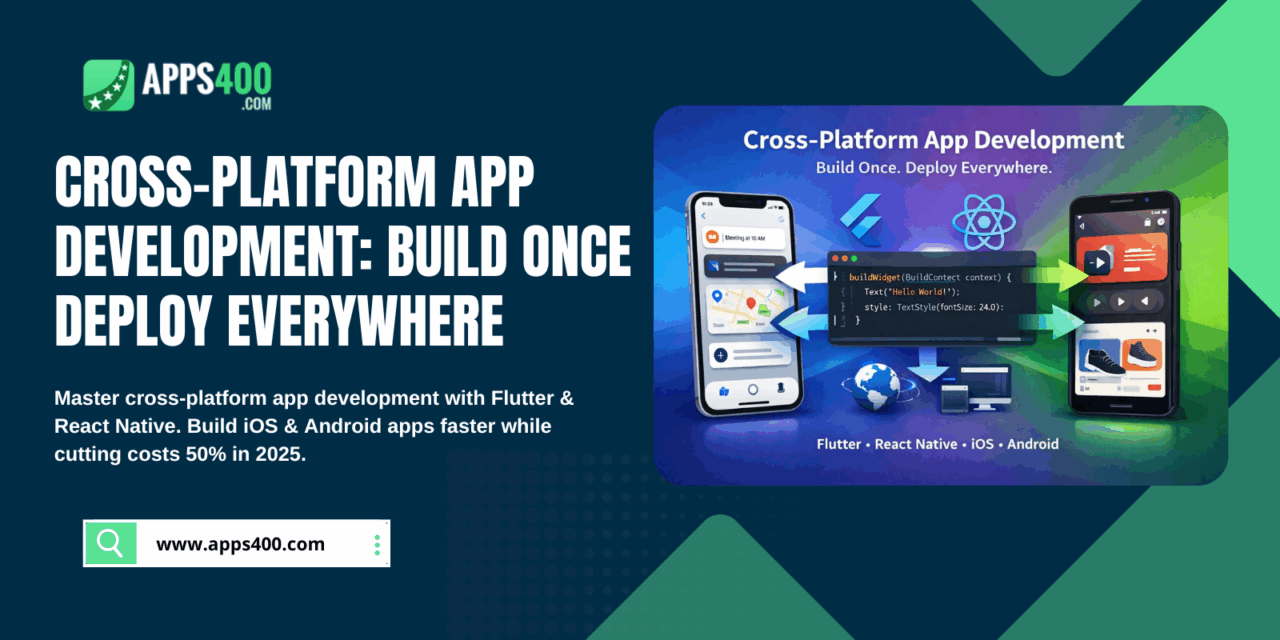
- Split screen showing iOS and Android devices
- Code editor with Flutter/React Native code
- Arrows connecting single codebase to multiple platforms
- Flutter and React Native logos
- Text overlay: “Cross-Platform App Development”
- Apps400 logo
- Modern tech gradient (blue, green, purple)