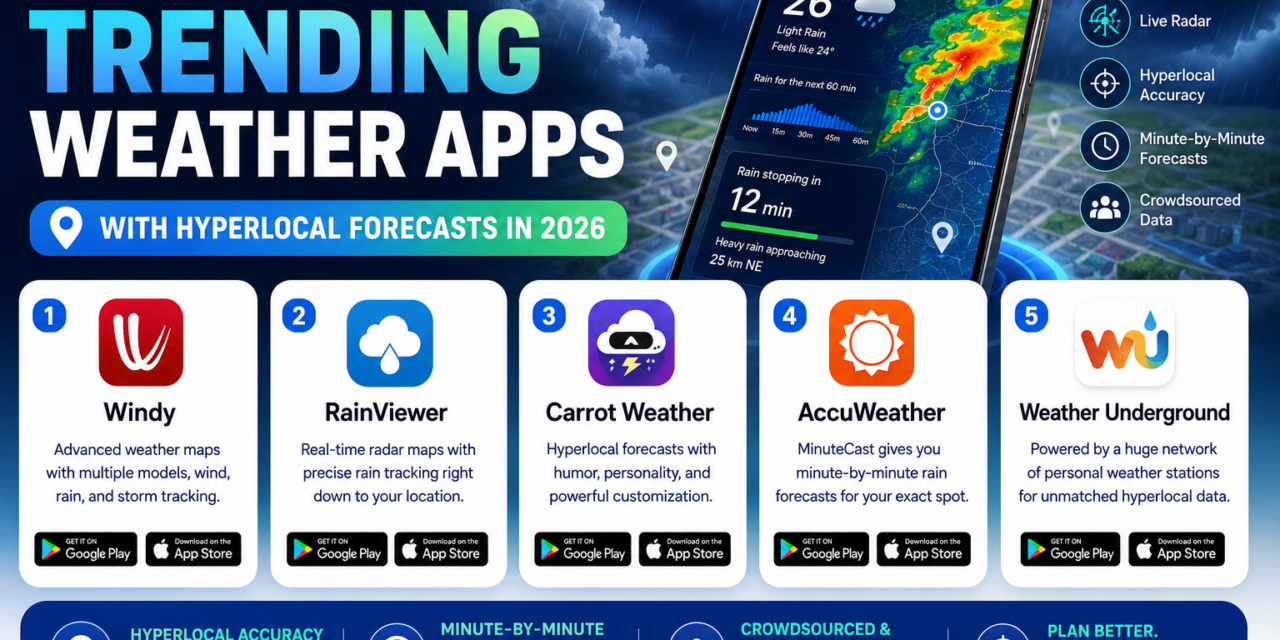
A forecast that says ‘60% chance of rain in your city’ is nearly useless when the rain hits one neighborhood and completely misses another twenty minutes away, which is exactly the gap hyperlocal weather apps have been built to close. Rather than relying on a single regional data point, these apps blend radar, crowdsourced reports, and dense sensor networks to predict conditions down to a specific street or even a single block, often with minute-by-minute precision for the next hour. That level of granularity has genuinely changed how people plan their day, from deciding when to leave for a walk to knowing exactly when a storm will pass. Here are five weather apps trending in 2026 for genuinely local, accurate forecasting that goes well beyond a generic five-day outlook.
Windy

Windy overlays multiple international weather models on an interactive map, letting users compare predictions side by side rather than trusting a single source blindly. Its wind, precipitation, and storm tracking layers have made it a favorite among pilots, sailors, and outdoor enthusiasts who need genuinely granular data.

RainViewer

RainViewer specializes purely in radar visualization, showing precipitation movement with impressive detail and near real-time updates, making it a genuinely useful companion app even alongside a more general-purpose weather app for anyone specifically tracking incoming rain.
Carrot Weather
Carrot Weather pairs genuinely accurate hyperlocal forecasting with a distinctive, humor-filled personality that sets it apart from the typically dry, purely functional interface of most competitors, while still offering deep customization for users who want more serious data views.
AccuWeather

AccuWeather’s MinuteCast feature delivers minute-by-minute precipitation predictions for your exact location, a genuinely useful tool for deciding whether to leave now or wait fifteen minutes for a passing shower to clear.
Weather Underground
Weather Underground taps into a genuinely massive network of personal weather stations run by everyday users, giving it hyperlocal data density that official government stations alone often can’t match, particularly in suburban and rural areas.
Why Hyperlocal Accuracy Actually Matters
Weather prediction has always been genuinely difficult at a hyperlocal level, since small variations in elevation, urban heat effects, and coastal proximity can create meaningfully different conditions within just a few kilometers of each other. The apps above address this in different ways, some through denser sensor networks, others through crowdsourced reporting, but the underlying goal is the same, closing the gap between a generic regional forecast and what’s actually happening outside your specific window. For anyone whose daily plans genuinely depend on weather, commuting by bike, outdoor work, or simply deciding whether to bring an umbrella, that extra layer of precision can meaningfully reduce the number of times a forecast gets it wrong for your exact location. Even a modest improvement in forecast accuracy adds up to real time and hassle saved over the course of a year.
No weather app is ever going to be perfectly accurate, forecasting inherently deals in probabilities rather than certainties, but the apps above consistently outperform generic built-in weather widgets specifically because they’re built around genuinely local data rather than a single regional average. Try pairing a radar-focused app like RainViewer with a more complete forecasting app like Carrot or AccuWeather, the combination tends to catch more nuance than relying on any single app alone. Checking two independent sources before making outdoor plans is a small habit that consistently pays off more than trusting whichever app happens to be open at the moment.