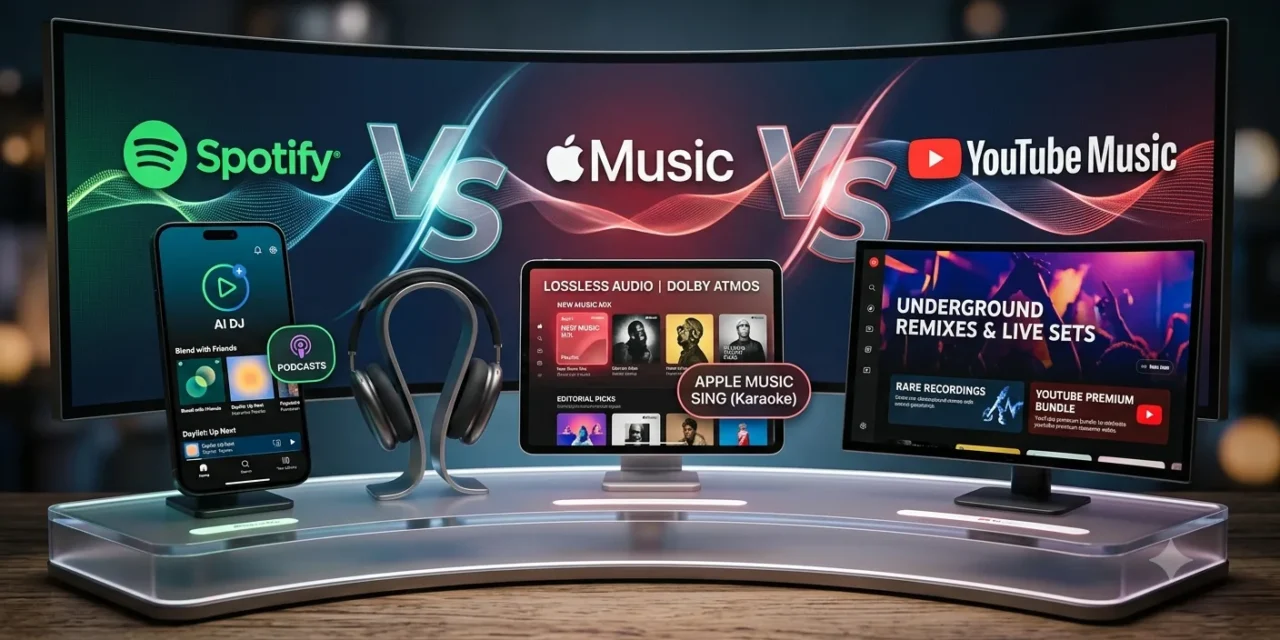
The music streaming war shows no signs of ending. In 2026, all three major platforms have raised their game – better audio quality, AI-powered recommendations, and new social features have each evolved in ways that make the choice between them more interesting than it has been in previous years. With subscriptions all sitting at a similar price point, the decision between Spotify, Apple Music, and YouTube Music comes down to something more specific than cost. This comparison tests each platform across the dimensions that actually matter for daily listeners.
Audio Quality in 2026 – The Gap Has Narrowed
Apple Music maintains its lead in audio quality with lossless streaming and Dolby Atmos Spatial Audio available on all plans at no extra charge. When listening through good headphones or earbuds, the difference between Apple Music’s lossless tracks and a standard compressed stream is genuinely audible – more detail in the high frequencies, better instrument separation, and a more dimensional sound overall.
Spotify launched its HiFi lossless tier in late 2025 as part of Spotify Premium, closing the gap that existed for years and making audio quality a less decisive factor for audiophiles choosing between the two leading platforms. The quality matches Apple Music’s lossless output on supported hardware.
YouTube Music offers up to 256kbps AAC streaming. This is good quality for everyday listening through earbuds and phone speakers but there is no lossless option in 2026. For most users the difference from lossless is imperceptible on typical listening hardware, but for serious listeners investing in quality headphones, it is a clear step below the other two.
Music Discovery and AI Features
Spotify’s AI DJ remains the best discovery tool across all three platforms. It curates a continuous radio-style mix with a voice that explains why each song was selected – based on your listening history, mood signals, and time of day. The Daylist feature creates a personalised playlist that updates multiple times per day matching what the AI predicts you want to hear at that specific hour. These features work because Spotify has the most mature recommendation model built on the broadest listening history dataset.
Apple Music’s human-curated playlists from its editorial team remain the best in the industry for discovering quality albums across genres. The New Music Mix and genre-specific stations have improved noticeably in 2026. Apple Music Sing – the karaoke mode with real-time lyrics highlighting and adjustable vocal track volume – has no equivalent on Spotify or YouTube Music.
YouTube Music wins specifically for discovering emerging artists, rare recordings, and content not yet on traditional streaming platforms. Live concert recordings, DJ sets, fan-made covers, and tracks from artists who have not yet released on Spotify all exist on YouTube Music through its connection to the broader YouTube catalogue. For music discovery outside the mainstream, this is a decisive advantage.
Social Features and Shared Listening
Spotify’s Blend playlists merge your musical taste with a friend’s into a single shared playlist, and the Jam feature allows real-time collaborative queue control during shared listening sessions. These social features have no direct equivalent on Apple Music or YouTube Music and make Spotify genuinely more enjoyable for music discovery through friends.
Apple Music’s SharePlay on iPhone allows multiple listeners to join a shared playback session where anyone in the group can add songs to the queue and control playback. The integration with iMessage and FaceTime makes this natural within Apple’s communication ecosystem.
Catalogue Size and Content
All three services offer over one hundred million tracks. The practical difference in catalogue for most genres is minimal. Apple Music has the strongest classical and jazz curation. YouTube Music has the deepest library of live recordings, unofficial remixes, and DJ sets. Spotify has the most podcasts integrated alongside music for users who prefer a single app for both formats.
Pricing in 2026
All three individual plans are priced at approximately eleven to thirteen dollars per month in most markets. Student discounts, family plans, and bundled offers vary. YouTube Music Premium includes ad-free YouTube which adds significant value for video viewers. Apple Music’s family plan covers up to six people. Spotify offers duo plans for two people at one address.
Our Pick by User Type
- iPhone users in the Apple ecosystem with quality headphones: Apple Music for the best hardware integration, lossless quality, and Spatial Audio
- Android users who want the best discovery experience and podcast integration in one app: Spotify
- Already paying for YouTube Premium or wanting to discover emerging artists and rare content: YouTube Music
Download Spotify on the Play Store or App Store at www.spotify.com. Download Apple Music on the App Store. Download YouTube Music on the Play Store or App Store