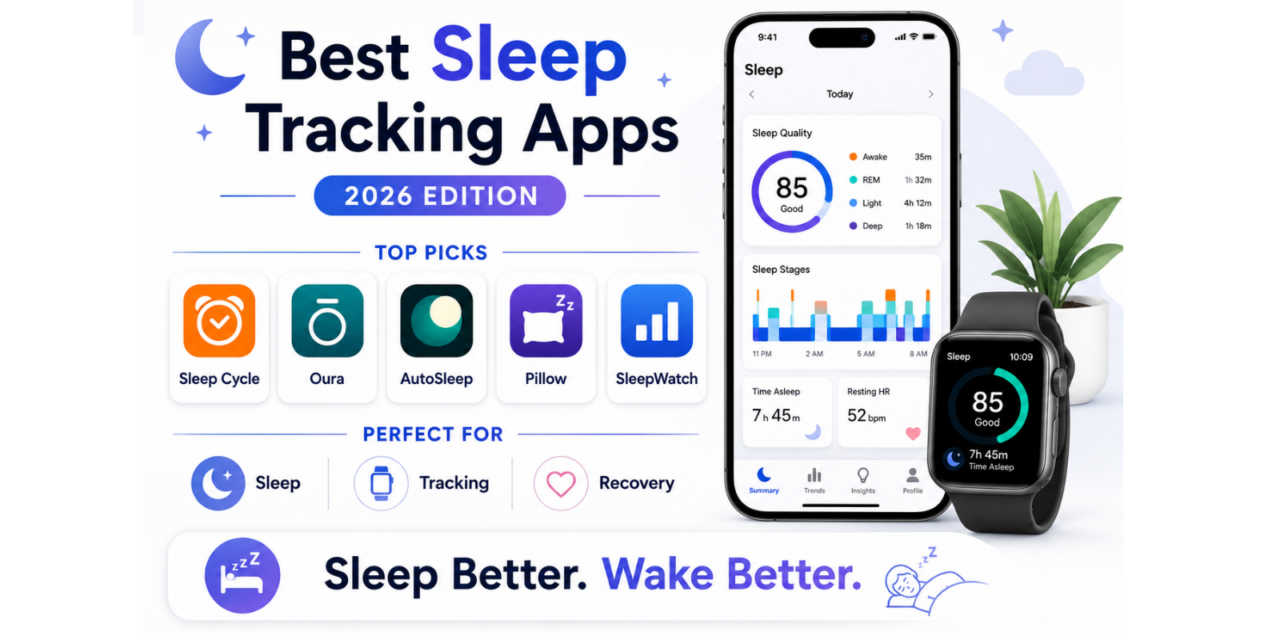
Sleeping eight hours and still waking up exhausted is one of the more common complaints modern sleep science can now actually explain, and a good sleep tracking app is often the fastest way to see why. Instead of guessing whether it was the late coffee or the scrolling in bed, these apps break the night down into light, deep, and REM stages, flag disruptions like snoring or restlessness, and quietly build a pattern over weeks that a single bad night could never reveal on its own. Some rely on a wearable for hard data, while others use just your phone’s microphone and motion sensors sitting on the nightstand. Here are five sleep tracking apps worth trying in 2026, whether or not you already own a smartwatch. Most also sync with health platforms like Apple Health or Google Fit, so the data doesn’t stay siloed in one app but feeds into a broader picture of overall wellbeing over time.
Sleep Cycle

Sleep Cycle uses your phone’s microphone and accelerometer to detect sleep phases without any wearable at all, then wakes you during light sleep within a chosen window so mornings feel noticeably less groggy than a jarring alarm at a fixed time.
Oura (via Oura Ring)
Oura pairs with its dedicated ring hardware to deliver some of the most detailed sleep and readiness scoring available, tracking temperature shifts and heart rate variability overnight to flag recovery issues before you’d otherwise notice them.
AutoSleep
AutoSleep works quietly in the background on Apple Watch, requiring no manual start or stop for tracking, and translates raw sleep data into a simple daily quality score that’s easy to glance at without digging through charts.
Pillow
Pillow adds detailed snoring and sleep talking audio recording alongside standard stage tracking, letting users actually listen back to disruptions rather than just seeing a graph that says sleep was interrupted.
SleepWatch
SleepWatch focuses heavily on trend tracking over time, correlating sleep quality against factors like caffeine intake or workout timing logged manually, helping users spot the specific habits actually hurting their rest.
Choosing between wearable-based and phone-only tracking comes down to how much accuracy you actually need versus how much friction you’re willing to accept every night. Oura and AutoSleep deliver noticeably more precise data because they read real biometric signals rather than inferring movement from a nightstand, but that precision requires wearing a ring or watch to bed, which not everyone finds comfortable. Sleep Cycle and Pillow remove that friction entirely at some cost to accuracy, relying on motion and sound rather than direct physiological signals. Whichever you choose, the real value shows up after two or three weeks of consistent use, not the first night, since a single reading rarely reveals much beyond confirming you had a rough night, something you already knew before opening the app. It’s also worth pairing a sleep app with basic habit changes rather than expecting the tracking alone to fix anything, since the most common culprits these apps reveal, late screen time, inconsistent bedtimes, and evening caffeine, still require an actual behavior change once identified.
A sleep tracking app won’t fix a bad sleep schedule on its own, but it removes the guesswork about what’s actually causing the problem, whether that’s late caffeine, an inconsistent bedtime, or a restless partner. Start with whichever option matches the hardware you already own, and give it a few weeks before deciding whether the data is actually changing how you sleep.