The original Nintendo Switch was a landmark product – a genuine dual-use home console and portable device that created its own market category. The Switch 2, released in 2025, does not try to reinvent this concept. Instead it refines it with better hardware, a bigger screen, and improved Joy-Con mechanics that address several longstanding frustrations with the original design. After six months of daily use across both docked and handheld modes, here is the complete assessment.
What Is New in Nintendo Switch 2
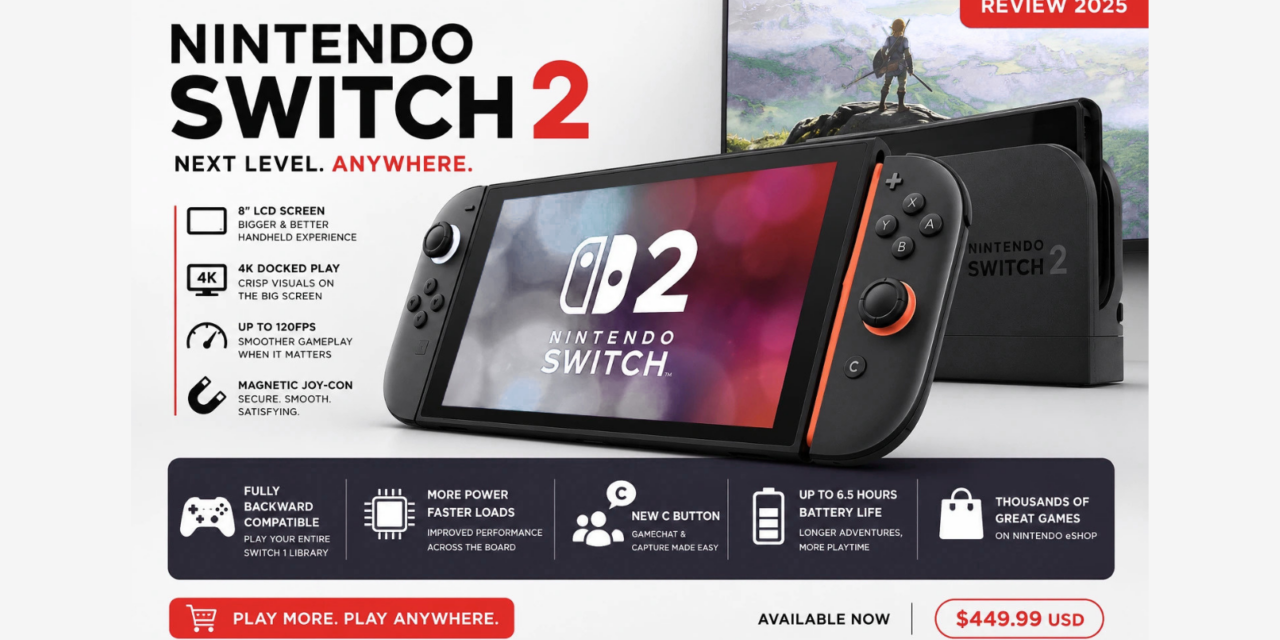
- 8-inch LCD screen up from 6.2 inches on the original – noticeably better for handheld gaming sessions
- 4K output when docked with a compatible 4K television
- 120fps support in select first-party and third-party titles
- Magnetic Joy-Con rails replacing the original slide-in mechanism – a significantly more satisfying and secure attachment
- New C Button on the right Joy-Con for chat and capture functions
- Full backward compatibility with the entire Nintendo Switch 1 game library
- Significantly improved processing power reducing loading times across the entire library
The Performance Gap Over Switch 1
The performance improvement over Switch 1 is real and visible in everyday use. The Legend of Zelda Tears of the Kingdom runs at a locked 60 frames per second on Switch 2, compared to 30fps on Switch 1. Mario Kart World – the launch title designed specifically for Switch 2 hardware – runs at 60fps in handheld mode and up to 120fps when docked on a 120Hz television.
For older games that received Switch 2 patches, the improvements vary. Some received simple resolution upscales, others received full performance mode additions. Nintendo has been more proactive about first-party game updates than most third-party publishers, but the back-catalogue enhancement situation will continue improving as more developers release patches.
The 8-Inch Screen – A Genuine Improvement
The larger screen makes a meaningful difference for handheld gaming. Text is easier to read, the increased size reduces the squinting that smaller phones’ details required on the original screen, and the improved brightness handles outdoor use better. The display technology is still LCD rather than OLED, which means the Switch 2 cannot match the black levels and colour vibrancy of the OLED Switch 1 model.
This is the most significant trade-off for users considering upgrading from the Switch OLED specifically. The Switch 2 screen is larger and runs at higher resolution, but it lacks the OLED advantage in display quality. For users upgrading from an original Switch or Switch Lite, the improvement is unambiguous.
Joy-Con Changes – Finally Getting It Right
The magnetic Joy-Con attachment mechanism eliminates the drift issue that plagued original Joy-Cons and the occasional feeling that the original rails were not quite secure enough for confident portable use. The magnets hold firmly during normal play and separate cleanly when intentional. The haptic feedback system has also improved, with more nuanced HD Rumble sensations that game developers are beginning to use more creatively.
The new C Button on the right Joy-Con opens Nintendo’s GameChat service for voice communication. The implementation is straightforward and works well for coordinating with friends during online multiplayer, though Nintendo’s online ecosystem still lags behind Sony and Microsoft’s networking infrastructure for competitive multiplayer experiences.
Backward Compatibility in Practice
Every Nintendo Switch 1 game works on Switch 2. This is the single most important feature for existing Switch owners considering the upgrade – your entire library transitions without any repurchasing. The backward compatible games run with improved loading times and more stable frame rates in many cases, even without specific patches.
For new Switch buyers with no existing library, the backward compatible catalogue of thousands of excellent games – Breath of the Wild, Tears of the Kingdom, Mario Odyssey, Splatoon 3, Pokemon Scarlet and Violet, and hundreds of indie titles – makes the Switch 2 a remarkable value proposition from day one.
Battery Life
Nintendo claims two to six and a half hours of battery life depending on the game. In testing with demanding titles including Mario Kart World, real-world handheld battery life was approximately two and a half to three hours. Less demanding games including Stardew Valley and older Switch 1 titles achieve four to five hours. The larger battery compared to Switch 1 is a modest but genuine improvement for light gaming use.
Should You Upgrade From Switch 1?
For players who primarily use the Switch in handheld mode and own graphically demanding games: yes, the screen size improvement and performance gains are substantial enough to justify the upgrade. For players who primarily use the Switch docked on a 1080p television and play older or less demanding titles: the improvements are real but less visually dramatic and the upgrade is less urgent.
Players who have never owned a Switch should buy a Switch 2 without hesitation – the backward compatible library plus all new releases makes it the better purchase at any point in 2026.
The Nintendo Switch 2 is available at www.nintendo.com from four hundred and forty-nine dollars and ninety-nine cents in the US. Browse the full game library and accessories at the Nintendo eShop.