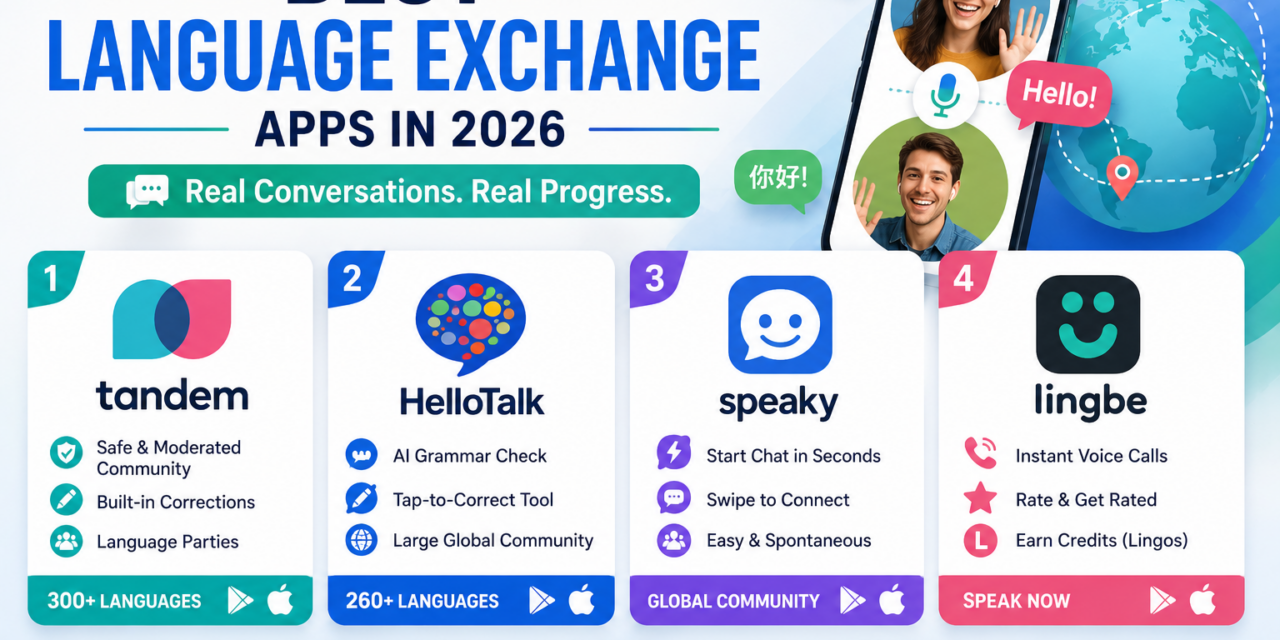
No amount of vocabulary drilling or grammar review quite replaces the moment of actually holding a conversation with a native speaker, stumbling through a sentence, and getting corrected in real time. Language exchange apps have built an entire category around exactly that experience, connecting learners directly with native speakers of their target language who, in turn, are usually learning the visitor’s own language back. The best apps in this space have moved well beyond a simple profile-matching system, adding built-in correction tools, safety moderation, and voice or video calling that make it possible to get genuine speaking practice without ever leaving the app. Here’s a look at four of the strongest options for real conversation practice in 2026.
Tandem
Tandem has built a reputation as the more structured, quality-focused option among the major language exchange apps, with around 10 million users worldwide and a matching system based on language goals, interests, and learning level rather than just proximity. Its correction tools let partners suggest fixes directly within a conversation, and its mandatory profile review combined with active human moderation has made it a noticeably safer environment than some open-chat alternatives, a detail that matters especially to women and younger users. Tandem supports over 300 languages, including a dozen sign languages, and its Language Parties feature adds group audio spaces for practicing alongside multiple learners at once rather than only one-on-one.
View on Play Store | View on App Store
HelloTalk
HelloTalk leans further into a social-media-style experience than Tandem, supporting more than 260 languages and combining direct messaging with a public Moments feed where users post questions or writing samples and get corrections from the wider community. Its built-in AI grammar check reviews messages for errors before they’re sent, and its signature correction tool lets a partner tap directly on a mistake and show exactly what was wrong alongside the fix, turning every conversation into a small lesson. The scale of HelloTalk’s active community tends to mean more available partners at any given hour compared to smaller apps, which matters for learners studying less common language pairs.
Speaky
Speaky focuses on getting learners into a conversation as quickly as possible, using a swipe-based profile browsing system that lets users start a text chat with a compatible partner within seconds rather than crafting an introduction message first. This makes it a good fit for learners who want low-pressure, spontaneous practice without the more deliberate partner-search process that apps like Tandem encourage. Its free core experience covers unlimited text chatting, and its broad international user base makes it reasonably easy to find partners for both widely spoken and less common target languages.
Lingbe
Lingbe takes an entirely different approach from the profile-browsing model, letting users press a single button to be instantly matched for a live voice call with an available partner, rather than scrolling through profiles and sending messages first. After each call, partners can rate one another on grammar, pronunciation, and fluency, and a mutual like unlocks ongoing chat and future calls with that same person. Its credit system, called Lingos, is earned by helping others practice your own native language, which keeps the exchange balanced and gives learners a built-in incentive to spend time on both sides of the conversation rather than only receiving help.
Choosing between these four largely comes down to how a learner prefers to start a conversation. Tandem suits learners who want a more curated, safety-conscious partner search, while HelloTalk’s larger, more social community tends to offer the most available partners at any given moment. Speaky works well for spontaneous, low-commitment text practice, and Lingbe is the clear choice for anyone who wants to start speaking immediately rather than browsing profiles first. Many serious learners end up using two apps side by side, one for structured partner search and one for quick practice sessions, rather than relying on a single platform to cover every kind of practice they need.
Conclusion
Language exchange apps remain one of the most cost-effective ways to build genuine speaking confidence, since the practice comes from real human conversation rather than a scripted exercise. Whichever app ends up being the right fit, treating the first week as a trial, since partner quality and availability vary meaningfully by language pair, tends to matter more than which specific app gets chosen first.