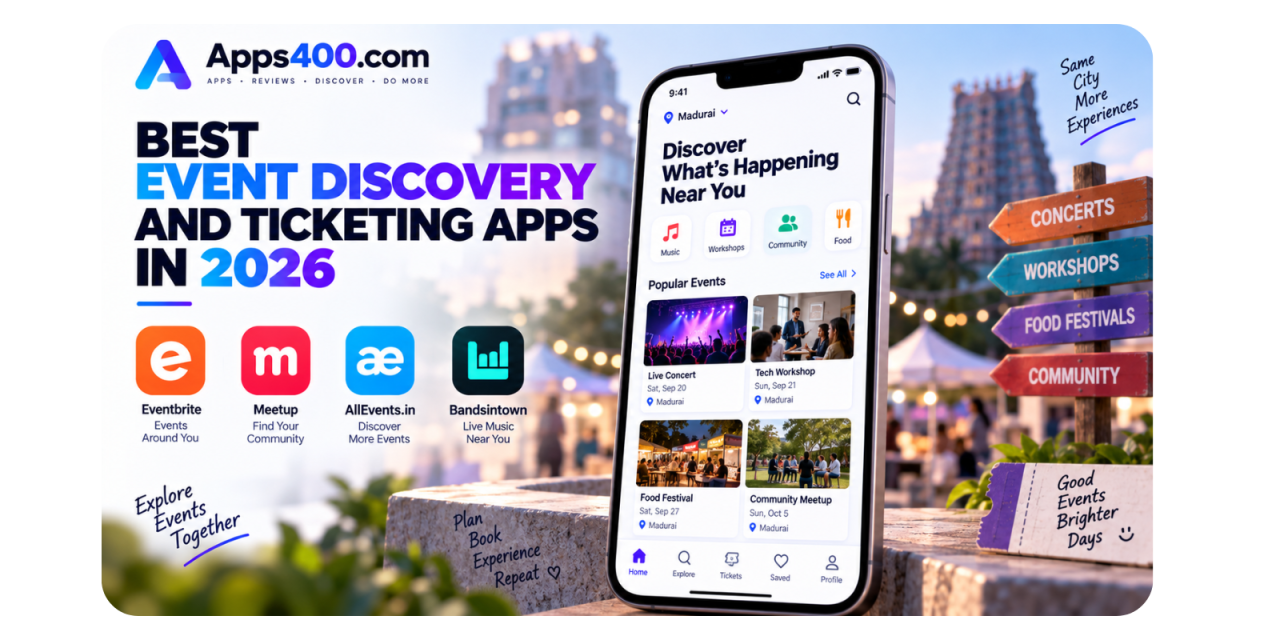
Finding something genuinely worth doing nearby used to mean checking a handful of scattered local listings, but a mature ecosystem of event discovery and ticketing apps has made it considerably easier to browse, book, and actually show up to concerts, workshops, and community gatherings. One notable industry shift worth knowing upfront: Bending Spoons, the Italian technology company known for previous acquisitions of platforms like Evernote and Meetup, purchased Eventbrite in 2026, and users of previously acquired platforms have historically seen real changes in pricing, features, and customer service following this kind of ownership shift. Here’s a look at what’s worth using this year.
Eventbrite
Eventbrite remains the dominant platform for event creation, ticketing, and discovery, leading independent rankings with the widest range of event types covered in the industry, concerts, food festivals, business conferences, wellness workshops, comedy shows, and more, all searchable through robust geographic and date filtering. Its updated discovery feed now delivers personalized recommendations alongside It-Lists, hand-picked local happenings curated by culture experts in select cities, and its social features let users import contacts to see when friends have booked something worth joining. Given its 2026 acquisition by Bending Spoons, prospective long-term organizers should factor in the real possibility of pricing or feature changes as the platform integrates under new ownership.
Meetup
Meetup remains the default choice specifically for finding recurring interest-based community groups rather than one-off ticketed events, connecting users to like-minded people through hobby groups, professional networking circles, and ongoing local communities built around shared interests. Its long-established, dedicated user base gives it a genuine discovery advantage that newer community platforms struggle to match, since a new hobby group posted on Meetup tends to find its first members considerably faster than the same group posted elsewhere. For anyone whose goal is ongoing community and repeated gatherings with the same group of people rather than a single ticketed event, it remains the strongest starting point.
AllEvents.in
AllEvents.in distinguishes itself through sheer aggregation scale, pulling together more than 250 million events across roughly 40,000 cities worldwide from multiple underlying sources rather than relying purely on events created natively within its own platform. This broad aggregation approach makes it particularly strong for discovering free local events specifically, since it surfaces free listings pulled from Eventbrite, Meetup, and other sources in a single unified search rather than requiring separate checks across multiple platforms. For anyone who wants the widest possible net cast across as many event sources as possible in one place, it remains one of the most comprehensive discovery tools available.
Bandsintown

Bandsintown focuses specifically on live music discovery, tracking favorite artists and sending concert alerts the moment a followed musician announces a tour date near a user’s location, filling a distinct niche that broader event platforms cover less precisely. Its integration with Spotify or Apple Music lets it automatically import existing listening history, surfacing concert recommendations for artists a user already listens to regularly without requiring manual artist-by-artist tracking. For music fans specifically who want the fastest possible notification the moment a favorite touring act announces a nearby show, it remains the most purpose-built tool in this category.
Choosing between these four largely comes down to what kind of event is actually being sought. Anyone looking for a diverse range of ticketed, one-off events across virtually any category should start with Eventbrite despite its recent ownership change, while people specifically seeking an ongoing hobby group or recurring community should default to Meetup’s dedicated discovery advantage for that use case. Budget-conscious users hunting specifically for free local happenings will get the broadest results from AllEvents.in’s aggregation across multiple sources, and music fans who want the fastest possible alert when a favorite artist announces a nearby show should rely on Bandsintown rather than a general event platform.
Conclusion
Local event discovery has matured into a genuinely capable category of apps, even as the underlying platform landscape keeps shifting through acquisitions and ownership changes. Whichever of these four ends up fitting a specific kind of event-seeking, the underlying payoff remains the same: turning a vague sense that something interesting is probably happening nearby into an actual plan worth showing up for.