, Walk into the back office of almost any small or mid-sized church and you will find the same thing: a laptop with three browser tabs open, a printed attendance register on the desk, a WhatsApp group for announcements, and a spreadsheet that nobody quite trusts anymore.
For decades, this was simply how churches operated. The congregation knew each other by name. The pastor kept notes in a journal. The secretary managed everything with a combination of goodwill, institutional memory, and Microsoft Excel. That worked when churches were smaller, when data regulations were looser, and when the alternative was genuinely expensive and complicated.
That is changing – and it is changing faster than most people in the church technology industry expected. The shift toward dedicated church administration software is being driven by a combination of maturing open source platforms, improving global connectivity, and a pandemic-era forced reckoning with what happens when a congregation has no digital infrastructure at all.
The Spreadsheet Problem Nobody Talks About
Spreadsheets are not inherently bad tools. For financial modelling, data analysis, and simple lists, they are excellent. The problem is that churches have been using them to do things spreadsheets were never designed for.
Managing a congregation requires tracking relationships, not just rows. A member is not simply a name and a phone number. They are part of a family unit, connected to a small group or ministry team, with an attendance history spanning years, a giving record that generates year-end tax documentation, a baptism date, and pastoral notes that need to remain private from the rest of the congregation. None of that information fits neatly into a spreadsheet without custom formulas, multiple interconnected tabs, and someone who understands how the entire system fits together.
When that person leaves – and they always eventually leave – the institutional knowledge goes with them. The spreadsheet remains, but the logic behind it is gone. The next volunteer inherits a system they did not build and cannot fully decode.
The second problem is access control. A shared Google Sheet containing 400 member records has no meaningful privacy architecture. Anyone with the link can see everyone’s address, phone number, and financial contribution history. In an era of increasing data regulation – GDPR in Europe, data protection frameworks across Africa and Asia, and growing congregational awareness of digital privacy – this represents a genuine liability rather than a minor inconvenience.
And then there is the operational overhead that accumulates invisibly. Every birthday message sent manuallyevent reminder compiled by hand, attendance register transferred from paper to spreadsheet by a volunteer who has better things to do on a Monday morning. The hidden labour cost of a spreadsheet-based church administration system is significant – it is just distributed across dozens of people in small amounts, which makes it easy to overlook until you model what it would cost at an hourly rate.
Why Churches Delayed Going Digital
The hesitation around church administration software is understandable once you know the history of the category.
The first generation of church management platforms arrived in the 1990s as desktop software – complex, expensive, and designed specifically for large American megachurches with full-time IT staff. They assumed a particular administrative structure, a particular payment infrastructure, and a technology budget that the vast majority of congregations globally simply did not have.
The SaaS era brought web-based platforms, which removed the installation barrier but introduced a different one: recurring subscription fees. A platform charging $100 to $200 per month sounds manageable until you calculate that over five years, that is $6,000 to $12,000 spent on software that stores data your church already owns. For a congregation of 150 people in a small town – or a growing church in Nigeria, Kenya, the Philippines, or India – that cost is genuinely prohibitive relative to ministry priorities.
Trust was also a significant factor. Asking a church to upload its complete membership database – including giving records, pastoral notes, and family information – to a cloud platform operated by a company they have never heard of requires institutional trust that takes time to establish. And given the history of SaaS platforms being acquired, pivoting their pricing, or shutting down, that hesitance was not irrational.
So churches waited. They – kept the spreadsheets, added more WhatsApp groups, bought another printer for the attendance registers.
What Changed
Three things shifted the equation simultaneously and fundamentally.
First, internet access improved dramatically in the markets where church growth is most actively happening – sub-Saharan Africa, Southeast Asia, Latin America, and South Asia. Churches in Lagos, Nairobi, Manila, São Paulo, and Chennai are now technologically capable of running modern administration software on standard shared hosting. The assumption that digital church tools were only practical for Western congregations no longer holds in 2026.
Second, open source software matured as a category. The arrival of properly engineered, MIT-licensed church management platforms means that the software itself no longer costs anything to licence. The conversation shifted from “can we afford this?” to “who handles the setup?” – which is a meaningfully different and much more tractable question for most congregations.
Third, the pandemic forced the issue at scale. When congregations suddenly could not meet in person in 2020, churches without digital infrastructure found themselves completely unable to communicate with their members, collect giving, or coordinate pastoral care at a distance. Churches that had already invested in administration software – even basic systems – had a critical operational advantage. Many congregations that had been postponing the decision made it very quickly under those circumstances. The ones who returned to spreadsheets afterwards found themselves making the same decision again, usually sooner.
What Modern Church Administration Software Actually Does
The best modern platforms consolidate everything a church needs to run its operations into a single connected system – not because consolidation is architecturally elegant, but because data is only genuinely useful when it is connected. A giving record that cannot link to a member profile is less useful than one that can. An attendance pattern that cannot be queried alongside pastoral notes is less actionable than one that is stored together.
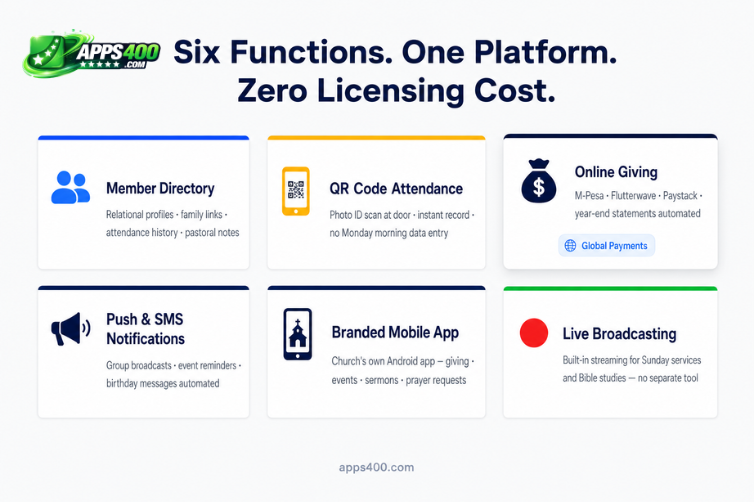
A complete church administration software platform typically covers the following functions as standard:
Member Directory and Profiles
Every member has a structured record – photo, contact details, family unit linkage, membership status, spiritual milestones, and any custom fields the church administration requires. Records are searchable, filterable, and exportable. This is the foundation that every other module connects back to. ChurchCMS’s member directory includes all of these as standard, with no cap on member count regardless of congregation size.
Attendance Tracking
Modern platforms have moved beyond paper registers entirely. QR code-based check-in systems let members scan a printed photo ID card at the entrance to mark their attendance instantly – no manual data entry, no Monday morning transcription. The attendance record connects automatically to the member’s profile, giving pastoral staff an accurate, queryable picture of engagement patterns over time. ChurchCMS includes printed QR code member ID cards as a standard feature, not a paid add-on.
Online Giving and Financial Management
Digital giving is now a baseline expectation for any serious church administration platform. Members give via the web or the companion mobile app, and every contribution is automatically recorded against their profile. Year-end giving statements are generated automatically. For churches operating outside Western markets, regional payment gateway support – M-Pesa, Flutterwave, Paystack, and others – is increasingly the difference between a giving module that is theoretically available and one that is practically usable.
Communication Tools
Push notifications, SMS, and email broadcasts sent to the whole congregation or to specific groups – without maintaining a separate mailing list or managing a group chat that someone has to manually update. Automated birthday and anniversary messages. Event reminders sent to registered attendees without manual intervention.
Event Management
A calendar of services, Bible studies, ministry events, and outreach activities – with automatic reminders to attendees and straightforward RSVP tracking. Events that sync automatically to the companion mobile app without a separate integration step.
Mobile Companion App
The expectation in 2026 is that members can access their church through a dedicated mobile application – not just administrators logging into a desktop dashboard. Prayer requests, event calendars, sermon archives, giving portals, and direct messaging to church leadership all accessible from a phone. ChurchCMS includes a branded Android mobile app for every church that uses the platform – published under the church’s own name, at no additional cost.
Live Broadcasting
Built-in streaming and video room capability for Sunday services, Bible studies, and special events. This was a paid add-on at most platforms before 2020 and has since become a standard expectation rather than a premium feature.
The Open Source Option – What It Means in Practice
One category of church administration software that has grown most significantly in the last few years is open source platforms – software where the complete source code is publicly available, free to use, and free to modify under the terms of an open licence.
The practical implication for a church is straightforward. You download the software, install it on your own server or shared hosting account – typically costing $3 to $10 per month – and run it permanently without paying a recurring licence fee. Your congregation’s data lives on your infrastructure. The software cannot be taken away if the vendor shuts down, gets acquired, or decides to triple the subscription price at renewal.
ChurchCMS is the most complete example of this model currently available. It is a full-featured church administration platform built on Laravel and Vue.js, released under the MIT open source licence, with a companion Android app. The feature set includes everything described above – member directory, online giving, QR attendance, event management, live broadcasting, a built-in church website CMS, and the mobile app – all included under a licence that costs nothing to use now or in the future.
For churches evaluating the specific membership and database module, the ChurchCMS documentation on running a church member database without a monthly fee covers the technical architecture and data ownership considerations in detail – worth reading before any platform decision is finalised.
Open source is not the right choice for every church. It requires either a developer to handle the initial setup or a willingness to engage a managed hosting service. But for churches with some technical capacity in their congregation, or those working with a developer partner, it removes the cost barrier entirely while providing complete data ownership and the ability to customise the platform to specific denominational or regional requirements.
ChurchCMS is currently used by churches in 14 or more countries, from small village congregations to urban churches with several thousand members. The platform does not change its pricing based on congregation size – because the licence cost is zero regardless.
What to Look For Before Choosing a Platform
If your church is evaluating church administration software for the first time – or considering switching from a current system – these are the questions that carry the most practical weight:
- Does it include a member-facing mobile app? Your congregation lives on their phones. A platform without a mobile app is already behind the expectation curve of most active congregants in 2026
- Where does your data actually live? Cloud-hosted platforms offer convenience and reduced maintenance overhead. Self-hosted platforms offer control, privacy, and protection from vendor decisions outside your control. Know which trade-off you are making
- What does it cost over five years, not per month? Monthly subscription fees compound significantly. A $79 per month platform costs nearly $5,000 over five years. Compare that against a self-hosted open source platform where the hosting costs $5 per month and the software is permanently free
- Can you import your existing member data? If you have years of member records, giving history, and attendance data in spreadsheets, you need a robust CSV import capability before committing to any platform
- What happens if you stop paying – or the vendor shuts down? With subscription software, access ends when payment ends and your data is in someone else’s hands. With self-hosted or open source software, your system and your data remain yours regardless of what happens to the vendor
- Is the platform designed for your market? A platform built for US megachurches may not support the payment gateways, languages, or compliance requirements relevant to a church in East Africa or South Asia
ChurchCMS addresses all six of these directly. You can get started with ChurchCMS for free and explore the full feature set before making any commitment. The demo and setup options include a one-time $99 installation service that handles everything from server configuration to data migration – making the open source path accessible to churches with no in-house technical expertise.
The Direction of Travel
The shift away from spreadsheets in church administration is not a trend with an uncertain outcome. It is a transition already underway, with one direction and no plausible reversal. The question for most churches in 2026 is not whether to adopt modern church administration software, but which platform fits their context, their budget, and their technical capacity – and how quickly they are willing to make the change.
The good news is that the options available in 2026 are genuinely better than they were five years ago. More capable, more affordable, increasingly designed for the global church rather than just the English-speaking Western market, and in some cases completely free to licence under terms that give the church permanent ownership of both the software and the data it holds.
The spreadsheet era in church administration is ending. What comes next is a church that knows its congregation better, communicates with them more effectively, manages giving and attendance without manual overhead, and spends less time on administration – and more time on ministry.
Frequently Asked Questions
What is church administration software and how is it different from a spreadsheet?
Church administration software is a purpose-built platform for managing the operational and relational complexity of running a congregation. Unlike a spreadsheet, it stores member data in a structured, relational format that links family units, attendance records, giving history, and pastoral notes to individual profiles. It includes access controls so different staff members see only what they need to. It automates repetitive tasks like birthday messages, event reminders, and giving statements. And it provides a member-facing interface – usually a mobile app – so congregation members can interact with the church digitally without administrative staff involvement.
Is free church administration software actually capable enough for a real church?
Yes – and the gap between free and paid platforms has closed significantly in recent years. ChurchCMS, released under the MIT open source licence, includes a full member directory, online giving, QR code attendance, event management, live broadcasting, a built-in church website, and a branded Android mobile app – all at no licensing cost. The platform is actively maintained, used by churches in 14 or more countries, and built on production-grade frameworks (Laravel and Vue.js). The relevant comparison is not “free vs paid” but “self-hosted vs cloud-hosted” – a distinction that affects where your data lives and who controls the platform, not the feature depth available.
Can a church with no IT staff use church administration software?
Yes. Most modern church administration platforms are designed to be operated by non-technical administrative staff once they are set up. ChurchCMS specifically offers a one-time $99 installation service that handles server configuration, software installation, data migration from existing spreadsheets, and initial admin training. After setup, the platform is managed through a standard web browser dashboard – no command line, no technical maintenance required. The $29 per month managed hosting option removes all server management responsibility from the church entirely.
How does open source church software protect a church’s member data?
Self-hosted open source church software stores all member data on servers controlled by the church – not by a software vendor. This means the vendor cannot access your data, change the terms under which it is stored, or take your data with them if the company shuts down or is acquired. Under GDPR in Europe, data protection frameworks in Africa, and similar regulations globally, this data sovereignty approach is increasingly aligned with compliance requirements. ChurchCMS documents its open source and self-hosting model in detail for churches evaluating this option.
What is the best church administration software for small churches?
For small churches specifically, the critical evaluation criteria are cost per member (which should be near zero), simplicity of daily operation, and mobile app availability. ChurchCMS meets all three – the licence is permanently free regardless of congregation size, the admin dashboard is designed for non-technical staff, and the branded Android app is included at no additional cost. For small churches in emerging markets where subscription fees represent a real ministry budget trade-off, the open source model removes the recurring cost decision entirely. Getting started with ChurchCMS requires only a hosting account, which typically costs $3 to $10 per month.
Apps400 covers web applications, Android apps, iOS apps, and productivity software. This article evaluates the church administration software category and references ChurchCMS as a representative open source platform in this space. Submit your application for review via our app submission page.